
Editorial cover adapted from a Multiply Labs company photograph; body images are original company photographs.
Chunyu Capital & AI|春雨·资本与未来
Chunyu Zhang|张春雨
October 15, 2026
AI Can Find the Drug. Who Will Manufacture It?
Multiply Labs’ $75 million round puts the next bottleneck in focus.
Chunyu Zhang | Chunyu Capital & AI
For several years, the most visible questions in AI drug discovery have concerned targets, molecules and development timelines. After nearly two decades of healthcare investing, I keep returning to a question further down the chain:
Even if we discover a promising therapy, can we manufacture it reliably enough for patients to receive it?
On October 6, San Francisco-based Multiply Labs announced a $75 million Series B led by Patrick Soon-Shiong and NantWorks, with participation from AstraZeneca, Teradyne, Lingotto and others. Founded in 2016 and a Y Combinator alumnus, the company says its total funding now exceeds $100 million. Company announcement
The investment interests me because faster discovery does not automatically create the capacity to turn an innovation into a consistently deliverable product.
Faster discovery does not create manufacturing capacity
Getting a therapy from the laboratory to a patient requires a stable process, qualified materials, consistent quality and dependable supply.
Cell and gene therapies make this especially clear. Manufacturing involves complex biological processes, and differences in who performs an operation or when it is performed can introduce variability.
Manufacturing therefore belongs inside the investment thesis from the beginning. It influences supply, cost and the sustainability of the business.
AI may increase the efficiency of finding opportunities. It does not automatically solve the problem of turning those opportunities into products.
The adoption strategy matters as much as the robot
Multiply Labs builds robotic clusters around manufacturers’ existing instruments to execute repetitive operations. Pharmaceutical companies own and operate the systems themselves, rather than outsourcing all production to Multiply Labs. Company announcement
That is an important commercial choice. The cost of adopting manufacturing technology includes much more than the purchase price: process integration, training, quality-system alignment and disruption all count.
A supplier must demonstrate that the improvement is worth the cost of adopting it.
Working around established instruments may reduce migration difficulty. It does not eliminate validation. The FDA’s process-validation framework spans process design, qualification and continued verification during commercial production. FDA guidance
The harder achievement is to introduce automation while preserving control, traceability and reproducibility.
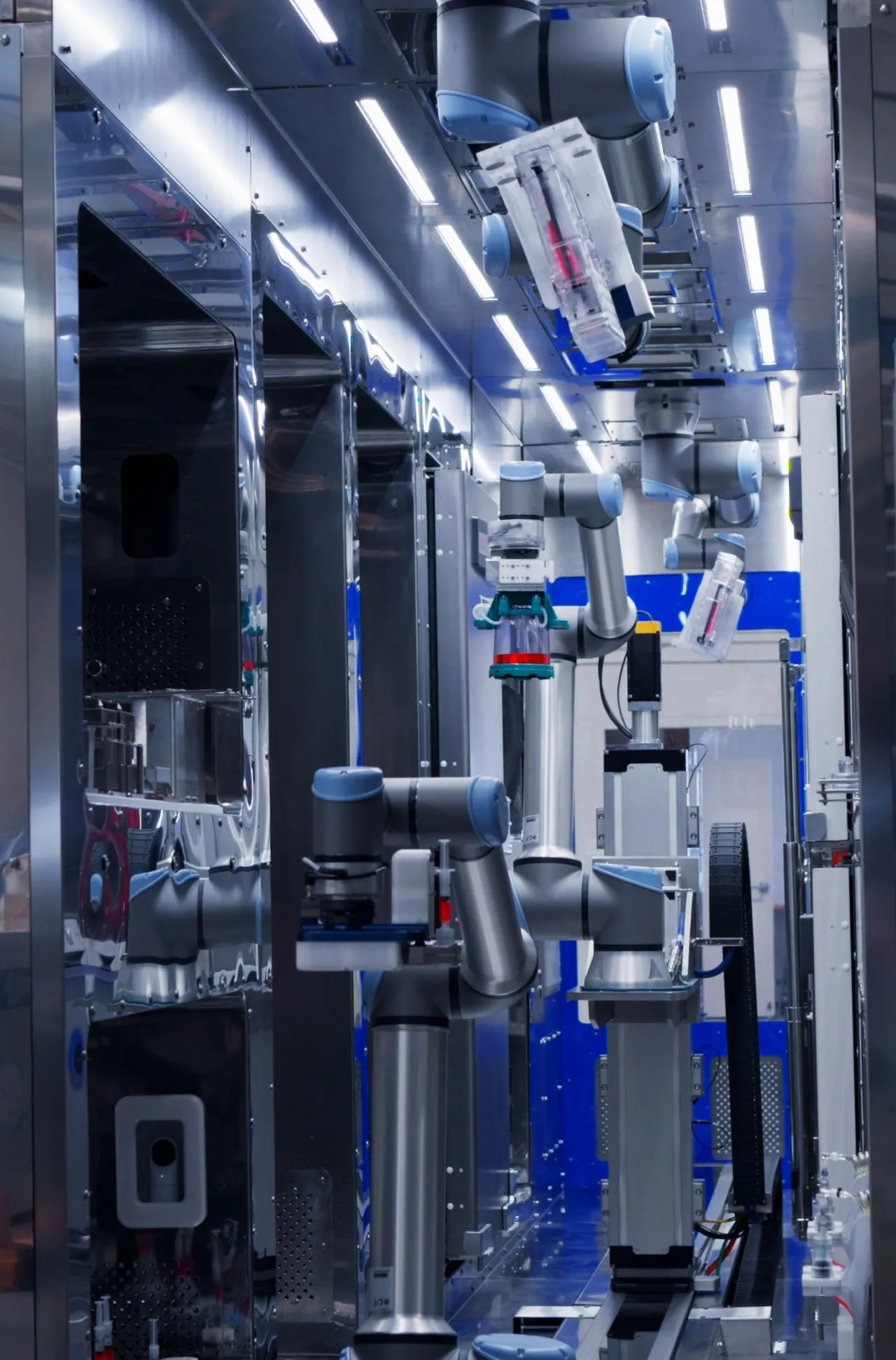
Company product photograph. Source: Multiply Labs; copyright retained by the company. Included for discussion of the system, not photographed by the author. Source
Why would a pharmaceutical company collaborate and invest?
AstraZeneca is particularly interesting here. In January 2026, the companies announced a collaboration to evaluate robotic systems for commercial-scale cell therapy manufacturing. AstraZeneca is now also an investor. Neither an evaluation collaboration nor an equity investment establishes that a large-scale procurement has been completed. January 27 announcement
Still, the relationship is worth examining. Procurement addresses an immediate need. Equity participation can also position an industrial partner to engage with a technology roadmap, product development and a longer-term relationship.
If a technology could affect future capacity and supply, a manufacturer has reasons to understand and test it early.
That is my interpretation, not a statement of AstraZeneca’s disclosed investment rationale.
For investors, industrial backing is a useful signal. The next evidence should come from orders, repeat purchases and sustained production use.
The shareholder list helps identify a direction. Customer behavior tests whether the value is real.
Read the denominator behind the performance headline
Multiply Labs’ product page advertises a 74% reduction in cost per dose and up to a 100-fold increase in throughput per square foot. These are company-reported metrics, not results that should be assumed for every therapy or facility. In particular, the throughput-per-area claim does not mean every manufacturing step runs 100 times faster. Product page
My diligence questions would be practical. Which therapy and process produced the result? What was the baseline? Do the cost calculations include depreciation, consumables, maintenance and validation? Does quality remain consistent at higher output?
The metric I care about is how much acceptable product can be delivered for each unit of total investment.
A robot may run faster while quality release, materials or a downstream operation remains the system bottleneck.

Company photograph showing a process-control interface. Source: Multiply Labs; copyright retained by the company. Source
Start with a valuable operation, then prove repeatability
This is also the lens I would bring to medical manufacturing and laboratory-robotics companies in China.
Research laboratories, biologic production and medical-device manufacturing have different requirements. They should not be treated as interchangeable markets.
But each can ask the same business question: which repetitive operations affect both cost and quality, with inputs and outputs clear enough to measure?
For a manufacturer with customers, process expertise and an established quality system, I would first identify a specific operation with substantial labor demand or recurring deviations.
Can automation demonstrably improve it? Can the result be repeated on a second line and for a second customer?
The first value is turning work dependent on individual skill into a capability that can be recorded, validated and replicated.
My investment view
I increasingly evaluate technology, manufacturing and commercialization together. A promising technology is not yet a product, and a product is not yet dependable supply.
Multiply Labs is addressing that gap. It must still show that complex deployments can become more standardized, delivery costs can fall and customer expansion can produce durable returns.
Manufacturing data also does not automatically belong to the equipment supplier. Data rights, permission to use information across customers and quality responsibilities will shape the platform’s eventual moat.
Three actions follow:
- Choose one real bottleneck and run a controlled pilot. Identify an operation that affects delivery time, batch consistency or labor cost. Record labor hours, error rates, waiting time and acceptable output before testing whether automation improves the result.
- Calculate cost per acceptable product, rather than equipment price alone. Include acquisition, process adaptation, validation, training, maintenance, consumables, downtime and quality release. Track at least one complete production cycle to establish whether total cost falls rather than simply moving elsewhere.
- Turn a demonstration into replicable commercial evidence. Define milestones for converting pilots into orders and orders into repeat purchases. Track production uptime, batch acceptance and repeat purchases, then reproduce the result on a second line or at a second customer site.
The capability worth backing is a system that can deliver a new medicine to patients reliably, compliantly and at low cost, alongside the technology that discovers it.
AI4Science reaches patients through experiments, processes and manufacturing.
Based on public information, for industry research and discussion. Not securities advice. Company-reported performance requires assessment against specific processes and deployments.