
September 26, 2026 | Global Health, Cross-Border Capital and Industry
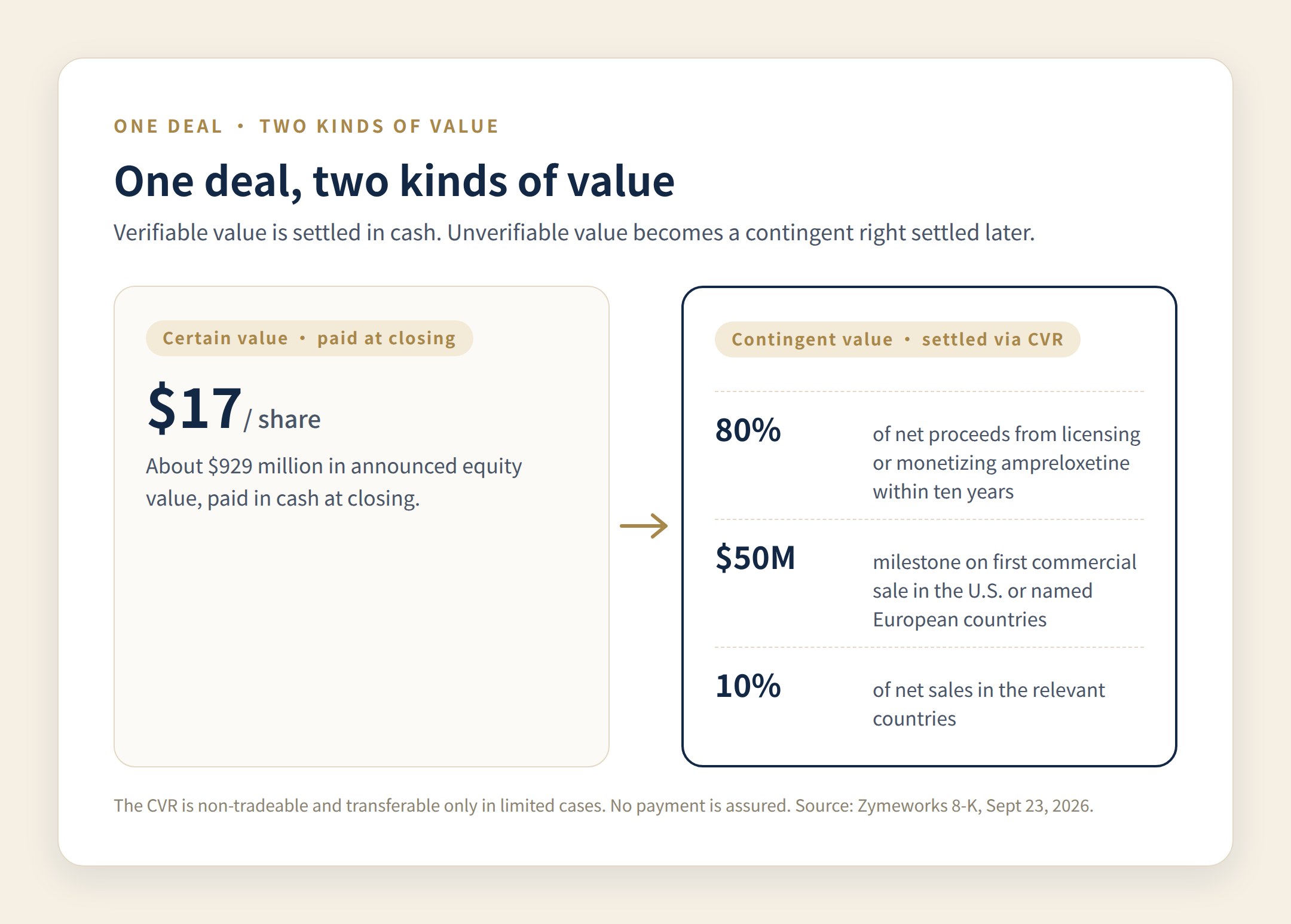
On September 23, Zymeworks completed its acquisition of Theravance Biopharma. When announced in June, the transaction carried an equity value of approximately $929 million in cash, or $17 per share. Theravance is now a wholly owned subsidiary of Zymeworks.
The most instructive part of the deal is how it handles an asset the two sides could not confidently value today: ampreloxetine. The Phase 3 CYPRESS study missed its primary endpoint in March 2026 and Theravance moved to wind down the program. Yet the closing documents preserve potential future licensing, commercialization and sales value for legacy shareholders through a non-tradeable contingent value right, or CVR.
My view is that a CVR does not turn a failed asset into a success story. It removes unverifiable value from the fixed purchase price. That can break a valuation deadlock, but it moves the dispute from price to post-closing control, effort obligations and the calculation of proceeds.
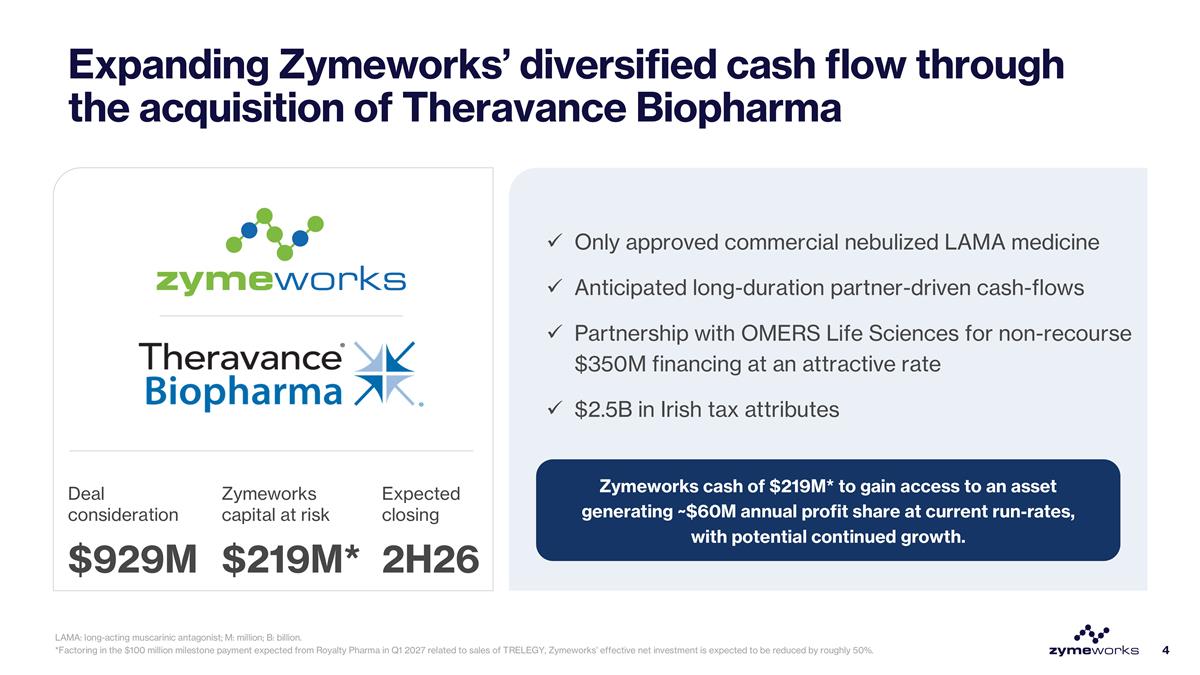
Zymeworks did not acquire only a research pipeline. Theravance held a U.S. profit share and ex-U.S. royalties in YUPELRI. Zymeworks said those interests were generating approximately $60 million in annualized cash flow at then-current run rates; 2025 U.S. net sales of YUPELRI were $266.6 million.
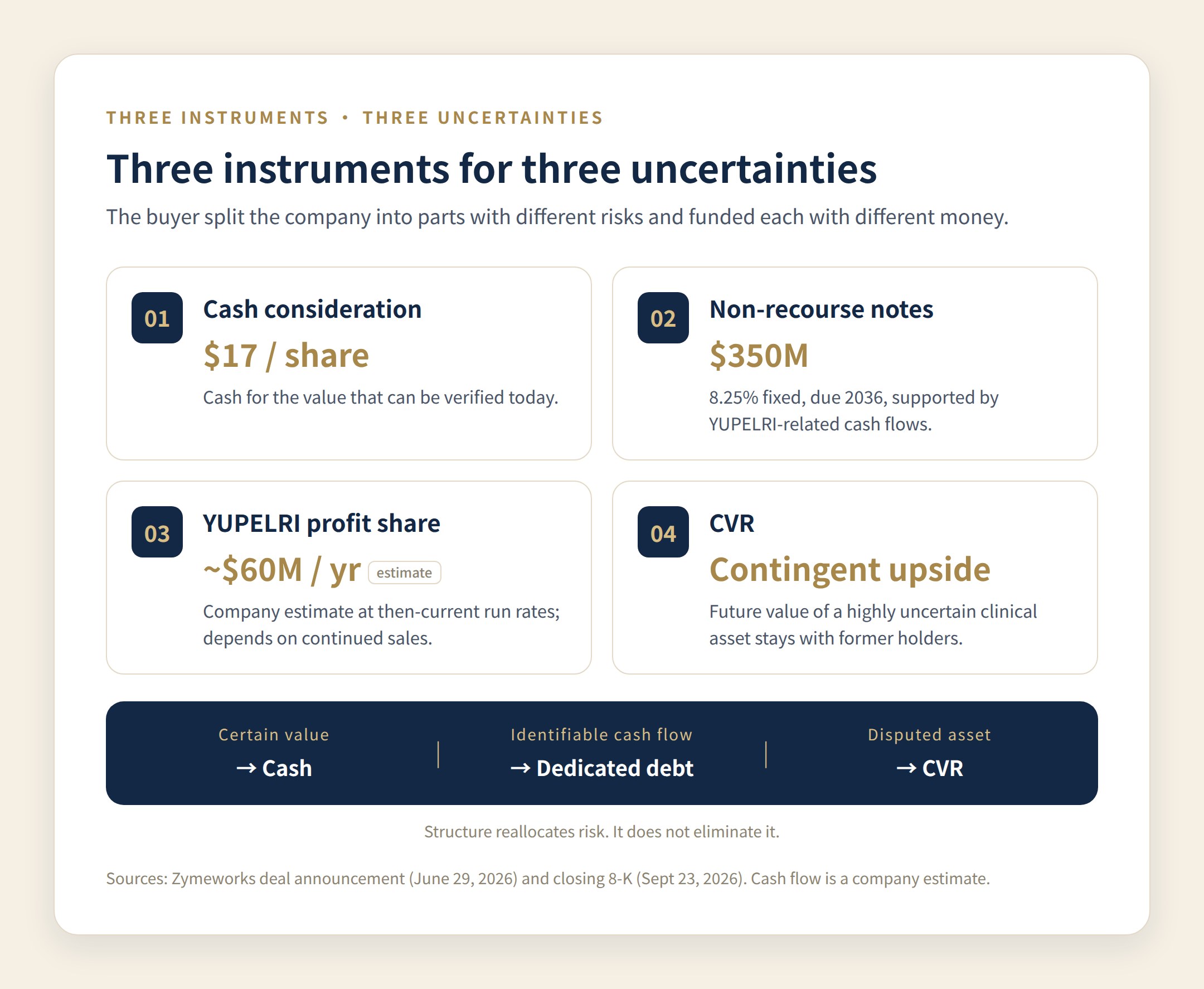
The financing was also unusual. The announcement described approximately $350 million of non-recourse notes supported by YUPELRI-related assets and profit-share cash flows, an expected Theravance net cash balance of approximately $360 million at closing, and approximately $219 million of Zymeworks cash. The closing 8-K states that the notes bear fixed interest of 8.25% and mature in 2036.
The buyer is therefore attempting to separate a cash-generating commercial interest from its broader R&D balance sheet. Cash flows from the acquired asset service part of the acquisition financing before the remaining economics enter the combined portfolio. This is not simply a research company spending cash to acquire another research narrative. It uses identifiable pharmaceutical cash flows to absorb part of the transaction risk.
Ampreloxetine was studied for symptomatic neurogenic orthostatic hypotension associated with multiple system atrophy. Theravance disclosed in March that CYPRESS did not achieve statistical significance on its OHSA composite-score primary endpoint and decided to wind down the program.
A missed primary endpoint does not make all future value impossible. Subsequent analysis continued to show certain biological activity, and the company kept evaluating regulatory and strategic pathways. The buyer therefore faced two opposing risks: paying today for a recovery that may never occur, or receiving all future upside without compensating legacy shareholders.
The CVR separates those risks. According to the September 23 8-K, each CVR can share in, subject to its terms:
The filing also says the CVRs are highly speculative and no payment is assured. They are non-tradeable, transferable only in limited circumstances, carry no voting or dividend rights and represent no equity ownership in Zymeworks or Theravance.
A CVR is often described as an extra upside option. The harder issue is that the buyer controls the asset after closing while a large share of potential value belongs to former shareholders.
If Zymeworks retains only 20% of ampreloxetine licensing proceeds, its incentive to devote personnel, trial capital and management attention may differ from the expectations of CVR holders. Legacy shareholders no longer control budgets, counterparties, licensing timing or development strategy.
This transaction includes a partial bridge. If ampreloxetine had not been licensed or monetized by closing, a Theravance designee could pursue opportunities on behalf of Zymeworks for twelve months after closing. But a ten-year CVR and a twelve-month active monetization window are not the same. Long-term value still depends on how the contract defines efforts, deductible costs, reporting and dispute resolution.
A CVR therefore converts a valuation disagreement into a governance problem. Weak drafting merely postpones the argument.
That is the central counterpoint.
Clinical assets are intrinsically risky, and ampreloxetine already missed a Phase 3 primary endpoint. The CVR cannot be traded, so holders lack a public exit and a reliable market price. Definitions of net proceeds, deductible expenses, development priority and transaction timing can materially affect any payment.
It would be wrong to add $17 in cash to a theoretical CVR maximum and describe the result as certain consideration. The CVR is a low-liquidity, outcome-dependent contractual right with limited holder control. It may preserve upside that would otherwise be transferred for free. It may also pay zero.
Likewise, the buyer’s estimates for annualized YUPELRI cash flow, a potential $100 million TRELEGY milestone and tax attributes depend on continuing sales, contractual conditions, tax usability and financing costs. Structure reallocates risk; it does not eliminate it.
First, separate assets before negotiating enterprise value. Commercial cash flows, development pipelines, tax attributes and post-failure optionality require different evidence and discount rates.
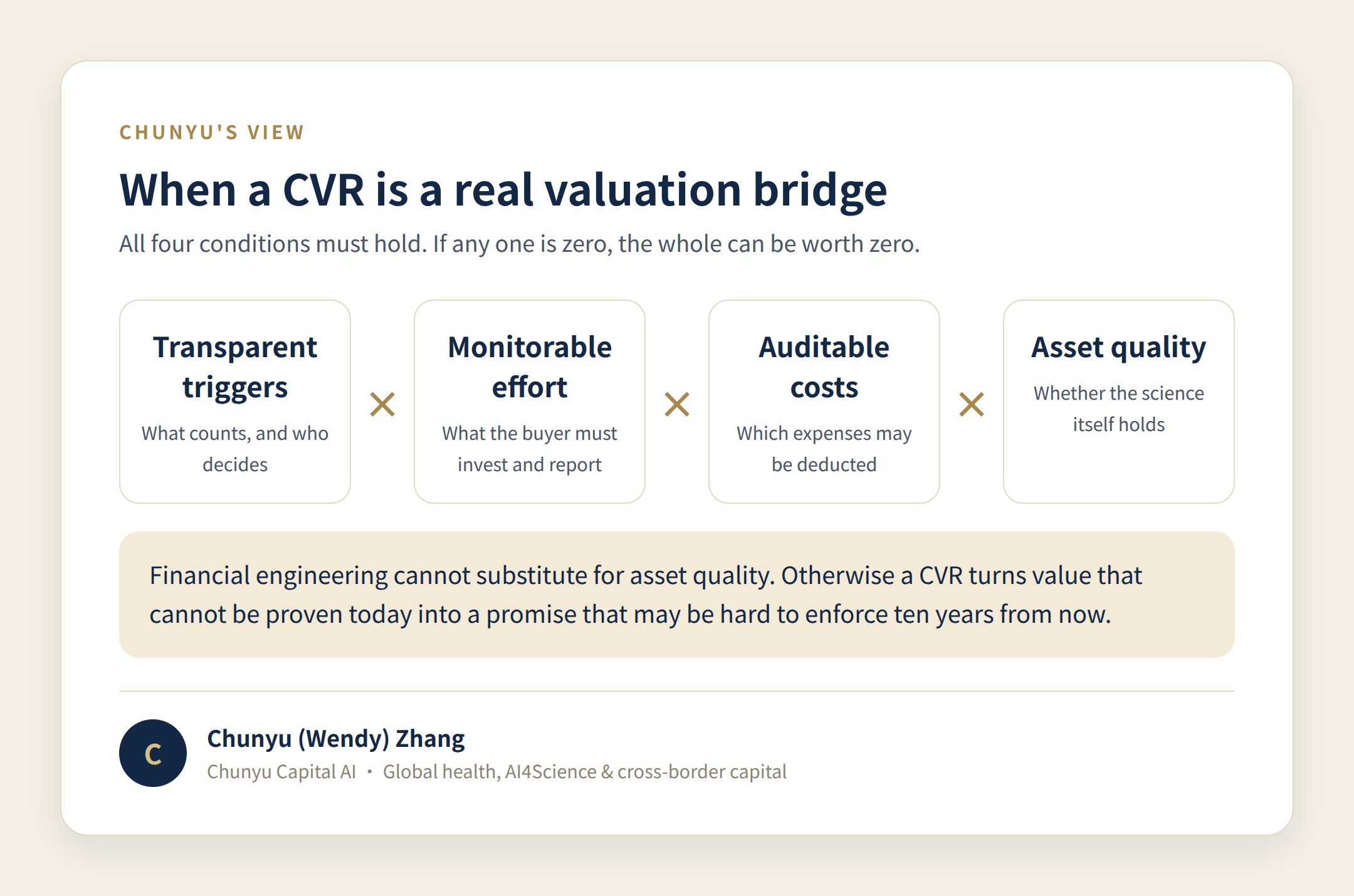
Second, use CVRs for clearly bounded disputed assets. Triggers, deadlines, net-proceeds definitions, cost deductions, reporting frequency and dispute mechanisms must be auditable. Putting a company’s vague “future potential” into a CVR usually creates another dispute.
Third, match financing to the source of cash flow where possible. Zymeworks used YUPELRI-related economics to support acquisition debt. That illustrates asset-liability matching, although the 8.25% coupon, cash-flow allocation and collateral package constrain future flexibility.
Fourth, failed data can retain structured value. After a primary-endpoint miss, value should fall sharply, but the choice need not be between success-case pricing and zero. CVRs, staged payments, licenses and revenue shares are mechanisms for writing uncertainty into the deal.
The hardest biotech M&A problem is not valuing a successful medicine. It is enabling a transaction when scientific evidence is incomplete and buyer and seller expectations diverge.
The Zymeworks–Theravance deal offers a clear case. Certain value receives cash. Identifiable commercial cash flows support dedicated debt. The most disputed clinical asset receives deferred, contingent consideration. Three instruments address three different uncertainties.
Financial engineering cannot substitute for asset quality. A CVR becomes a credible valuation bridge only when triggers are transparent, buyer obligations can be monitored and costs can be audited. Otherwise, it converts a value that cannot be proven today into a promise that may be difficult to enforce ten years from now.
A question for you: If you were a Theravance shareholder, would you value the CVR’s upside more—or the contract terms that govern the buyer’s effort after closing? I’d welcome your view in the comments.
This article is for industry research and capital-markets analysis only. It is not investment, medical, legal, tax or securities advice. CVRs, cross-border mergers and securities arrangements require review by qualified legal, tax and financial advisers.
CHUNYU CAPITAL AI
A cross-border healthcare investor with nearly 20 years of healthcare investment and industry experience, focused on medical devices, innovative drugs, AI4Science and cross-border capital markets. She works to connect the U.S. and Asian markets, helping healthcare and technology companies understand industry trends, financing pathways and global opportunities. Stanford GSB alumna.
A research and industry-connection platform focused on global healthcare, AI4Science and cross-border capital. Grounded in public facts, primary sources and a long-term industry perspective, it studies technology commercialization, corporate financing and capital-market pathways, offering founders, executives and investors independent, clear and actionable decision support.